The energy transition is in full swing. Solar panels are sprouting on rooftops, wind turbines are spinning offshore, and governments are pledging net-zero targets. But there’s a hidden snag: our electricity grids. They weren’t built for this tidal wave of renewable energy. And if we keep upgrading them the old-fashioned way, the costs will skyrocket into the hundreds of billions—or even trillions—globally.
The good news? There’s a smarter, cheaper, and more resilient way forward. Here’s how we can save billions on grid upgrades—without compromising reliability.
The Scale of the Problem
In the UK, connecting 8GW of new offshore wind requires around £20 billion in onshore grid reinforcements. That’s roughly £3 billion per gigawatt. To meet future targets of 100GW offshore wind and 40GW solar, the projected reinforcement costs could exceed £780 billion—close to one-quarter of national GDP (before even considering ongoing operational costs). [Source: Mark Howitt, Saving Billions on Grid Upgrades]
The Hidden Costs
Grid reinforcement is only half the story. Every gigawatt added carries an ongoing operational bill of around £300 million per year in maintenance, operations, and balancing services. Across decades, that’s another multi-trillion burden on taxpayers and consumers. And the more renewables we add, the higher these costs climb—exponentially.
A Smarter Solution: Storage + Renewables
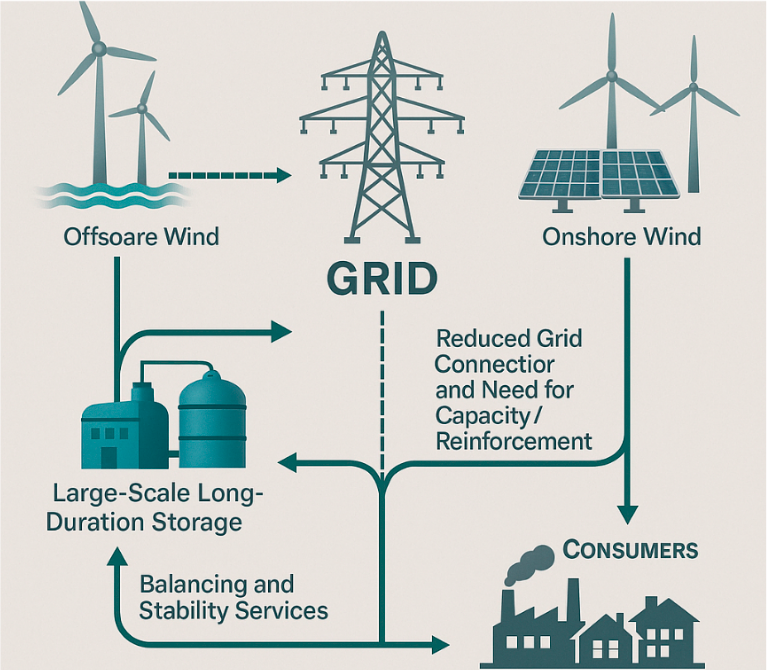
Instead of endlessly reinforcing grids, the smarter approach is to integrate renewables with large-scale, long-duration storage. Technologies such as Compressed Air Energy Storage (CAES) or pumped hydro can smooth out intermittency and deliver vital services like frequency regulation, inertia, and black start capability. This reduces the need for oversized grid connections and reinforcements—sometimes by as much as 50–90%.
For example, a 1GW CAES plant with 2GW input could save £2 billion in grid upgrade costs—while simultaneously delivering balancing and stability services that batteries alone can’t provide.
Why Multi-Tasking Storage Matters
Not all storage is created equal. Multi-service storage technologies can simultaneously provide balancing, stability, voltage control, reactive power, and even black start capabilities. By contrast, most batteries can only deliver a subset of these—and not all at once. This makes naturally inertial storage (like CAES) uniquely valuable.
Policy and Market Design: Unlocking the Savings
Here’s the kicker: the technology exists, but regulations haven’t caught up. Current frameworks separate grid operation from network operation, and they ‘salami-slice’ services into fragmented contracts that disadvantage integrated solutions. To unlock the billions in savings, governments and regulators need to:
✔ Define storage as its own category, not just a subset of generation.
✔ Enable long-term, broad contracts for multi-service plants.
✔ Incentivise first-of-a-kind projects with stable revenue models.
✔ Support integration of renewables + storage at project level.
The Bigger Picture: From Billions to Trillions
Globally, the stakes are even higher. If we pursue grid reinforcement as usual, the energy transition could cost trillions more than necessary—while leaving us with fragile and complex grids. But with the right mix of storage and regulatory reform, we can cut costs by two-thirds or more, build resilient systems, and accelerate the clean energy future.
Final Thought
Saving billions on grid upgrades isn’t about cutting corners—it’s about cutting smarter. By pairing renewables with the right kind of storage, and by redesigning our regulatory frameworks, we can unlock massive savings, stabilize our grids, and make the energy transition not only achievable—but affordable.
👉 Learn more about innovation in energy storage at scale: cleanergi.com

Marina Skorulskaja is Founder & CEO of GreenVision Strategies GmbH (Greenovest.ch), a strategic consultancy focused on regenerative business solutions, capital acquisition, and sustainable growth. Drawing on a cross-sector background in Food, Agriculture, Energy, Pharmaceuticals, and Medtech, she supports startups and SMEs in navigating complex market dynamics and building resilient, future-ready ventures. With a focus on translating visionary ideas into investable, scalable solutions, Marina is committed to shaping the next generation of businesses that thrive in and actively regenerate the fast-changing world.